


Lippy just got cleverer. She stayed awake half the night figuring it out, and now knows the what, where, how and who of trackbacks.
Congratulations, Lippy! Can you remind me, now? I figured it out once, too, and installed it, but then forgot it was there. Now I've forgotten what the point was.
(Lippy, this post is actually just an excuse to ping you, if I can remember how.)
Technorati Tags: trackbacks
Tuesday, June 21, 2005
Clever Lippy

Monday, June 20, 2005
Horror in the park
Today I went down to the little park again. I was meeting a colleague there, for a chat before work. While I was waiting for her I was treated to a glimpse of what is REALLY going on in the park. I thought these were harmless, ordinary pigeons, gathering around and begging for food. I really did. I had no idea. I fed them a bit, and then watched as they did a little preening after breakfast.
At least I thought they were preening. It looked like they were preening. See?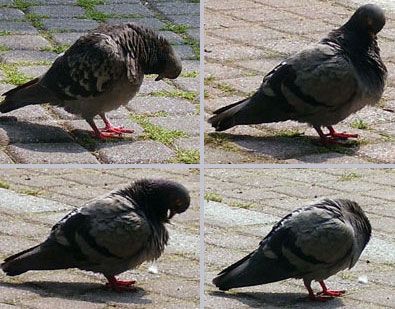
I'll admit I got a little concerned when the head disappeared, but the disappearing head IN NO WAY prepared me for what happened next.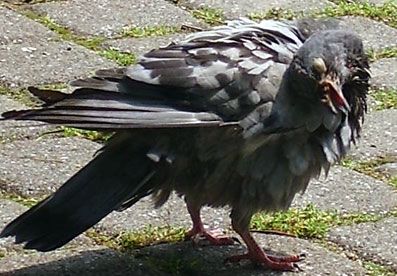
What was THAT?
Technorati Tags: pigeons
Sunday, June 19, 2005
You're fired!
The other day my boss shouted at someone (it might have been me), "YOU'RE FIRED!" Then he disappeared into his office, slamming the door.
He was joking, but the incident gave me a terrible flashback.
I was sixteen, and working in an office, and we had a new office junior. He was supposed to do all the dogsbody work: franking envelopes, stuffing envelopes, filing, running errands and so on. His job did not require any great intelligence, but he was hopeless. He just couldn't get anything right. On top of that he was terribly nervous and would freeze like a hypnotized rabbit when you even tried to talk to him. I took him over all his duties, helping him with them, even writing them down for him, and he barely responded. He'd stare, nod dumbly, and do it all wrong. He found it all incomprehensible. He'd concentrate hard on his job, not talking to anybody, reading and rereading his notes, office banter flying over his head - and still he got it all wrong.
This went on for a couple of weeks. I thought his nervousness and his numerous mistakes were due to this being his first ever job. I thought if he'd just relax a bit he'd probably be fine. After all, it wasn't exactly rocket science. Everybody was patient with him, although it was clear he wasn't a terribly successful hire. But you don't need great intelligence in a job like that, and we all thought he'd be fine after a while. We tried to include him in the office banter, sharing jokes and so on, but he didn't respond. He'd stare blankly, and go back to painstakingly feeding the envelopes into the franking machine the wrong way up.
At that place you weren't treated with kid gloves for long, though. The new person would be treated nicely for a few days, but eventually somebody's natural exuberance would erupt and the new worker would fall victim to a sudden and surprising practical joke. In this case, the someone turned out to be me. This was unintentional, however.
It happened when New Boy, whose name I now forget, did something wrong. I can't remember what it was except that it was almost unbelievable that he could get it wrong even once, and it created a lot of work for me. I noticed, pointed it out, and explained patiently how to do it properly. The second time he did it, a day or two later, I explained it again and added jokingly, "If you do that again you're fired!"
The very next day he did it for the third time. I was just about to go to lunch when I noticed and pointed his mistake out to him. I showed him the instructions I'd written down especially for him the time before. (I think there were three steps in the procedure.)
"Tut tut! Remember what I said?" I said, waggling my finger at him facetiously. "You've done it again! You're fired!"
Then I laughed like a maniac and went to lunch.
When I came back from lunch he wasn't around. I needed him to run some errand for me, so asked if anybody had seen him. One of my office mates told me, in hushed tones, that New Boy had been fired.
"I saw him packing up his stuff and leaving, and when I asked him what was going on he said he'd been fired," he explained. "He wouldn't talk about it. I wonder what he did wrong? Not that he ever did anything right, but..."
I was aghast. Who had fired him? My joke suddenly seemed in horrible taste. I had pretended to fire him, and he had got fired for real, the same day! How awful for him.
(I know, I know. I should have known what had happened. I didn't, though. It didn't even occur to me. I used to fire my coworkers a couple of times a day. IT WAS OBVIOUSLY A JOKE. SIXTEEN YEAR OLDS DO NOT FIRE PEOPLE.)
I went to our boss and asked why New Boy had been fired. The boss stared at me.
"What? He hasn't been fired," he said. "What gave you that idea?"
"But he told - " I said, and then I sat down suddenly as realization dawned, covered my face with my hands and blurted, "OH, SHIT."
My boss sat up straight. He'd never heard me swear before. He thought I was a good girl. He was a great boss and I liked him, but he wasn't the sort of person you swore in front of because he never swore himself. (I glued his telephone together one April Fool's Day and made him shout "OH MY GOODNESS!" He was not normal.)
I confessed what I'd done, apologising profusely.
The boss looked horrified, and leaped into action. He grabbed his phone (and it didn't stick - that was a dramatically successful joke but not a repeatable one) and called New Boy's home. New Boy's mother answered, and said he was there. It took a while to get him to the phone, though, and longer to persuade him to come back to work. The boss told him to take the rest of the day off.
After he got off the phone I started apologising again, but he held up his hand and stopped me. He'd gone red in the face and looked as though he might burst. I cringed. My boss had never got angry at me before, but I deserved it. I braced myself.
When he exploded with laughter I went limp with surprise. I'd been feeling so guilty I hadn't seen it coming at all.
He laughed until he cried.
Then he wiped his eyes and sighed. "What on earth are we going to do with that poor lad," he asked, shaking his head. "He's hopeless."
New Boy came back next day, and I was repentant. I apologised to him very, very sincerely. He accepted my apology (or at least stared at the floor for a while and didn't try to kill me or anything). Then he went back to his desk and continued to get everything wrong and to never understand anything that was going on. Not all that long afterwards he quit of his own accord.
I never fired anybody again. The fun had gone out of it.
Technorati Tags: office jokes
Lamb
I found some lamb in a supermarket the other day on my way home from work, and had a moment of excitement and joy. Lamb! It's so hard to find lamb here. Great, I thought, I'll have lamb for dinner.
Then I saw the price.
100 grams for 1000 yen.
(For my American readers, that's 0.220462262 pounds for 9.21022 USD.)
I had spaghetti for dinner.
Technorati Tags: Japan, lamb
Saturday, June 18, 2005
After we've gone
Trolling around the web this morning I got sidetracked from somewhere and ended up discovering Gunkanjima, in Nagasaki Prefecture.
Sometimes, when I am cycling or walking around the city here, I look at all the concrete under my feet and imagine the earth sleeping under there, waiting, waiting, to spring back to life. One day we will be gone, I think. One day those weeds growing through the cracks in the concrete will break through, and grow, and grow, and grow, because there will be nobody here to stop them. The cracks will get larger, tendrils of green will climb the buildings, the concrete will crumble, and vegetation will take over. We will be gone.
On Gunkanjima the people have been gone for thirty years. There appears to be very little green, perhaps because of the salt spray and the small size of the island, but the wind and weather have taken over.
Saiga Yuji, a photographer, is also fascinated by the decay of manmade structures, as evidenced by this photograph taken on Shijima, and particularly by Gunkanjima. Saiga has an online gallery of photographs of Gunkanjima, and they are extraordinarily evocative. He writes:
I was twenty-two when I first visited the island I had dreamed about ever since childhood. Much like a fortress built upon the sea, surrounded by high walls,the island possessed an air of a small kingdom, where its denizens boasted "There is nothing we don't have here." They were right. They did have everything within their miniature kingdom - except a cemetery. But, the irony of it was proven by the passage of time. Already, the island had been doomed to turn into an enormous graveyard.A more comprehensive account of the history of the island tells of the use of forced labour in the coal mine that was the island's only industry, and of the complete dependence on the people of the island on daily resources from the mainland.
Eventually, the mines faced an end, and in 1974 the world's once most densely populated island become totally deserted. The island, after all its inhabitants departed leaving behind their belongings, became an empty shell of a city where all its people disappeared overnight, as if by some mysterious act of God.
the dead island of Hashima delivers a lively warning about the importance of foresight. It offers a view of the end result of "development," the fate of a community severed from Mother Earth and engaged in a way of life disconnected from its food supply. In short, Hashima is what the world will be like when we finish urbanizing and exploiting it: a ghost planet spinning through space—silent, naked, and useless.I recommend reading this article before looking at the photographs.
How long is your city going to last? And what will it look like after it has been abandoned for thirty years?
(Addendum: There is some green on Gunkanjima. A German photographer, Juergen Specht, has a huge series of colour photographs online of Gunkanjima. Highly recommended.)
Technorati Tags: Japan, Gunkanjima, photography, abandoned city
Dear John
On Thursday in class some students were making up stories about what was happening in a picture in the textbook. In the picture, one man was reading a letter and looking very upset, and students were speculating about what the letter contained.
One of the students asked me how to say it was a letter from his girlfriend, breaking off the relationship. I explained, and then added,
"You could also call it a Dear John letter."
"Dear John letter?" said the student, looking puzzled.
"Yes. It means the same thing - a letter breaking off the relationship."
The student didn't believe me, or didn't get it, and looked it up in his dictionary. When he found the entry his eyes bugged and his jaw dropped. He looked at me, aghast.
"NO! No, Sensei! SHHH!" he said, glancing around the classroom. "Don't teach that! Don't tell us!"
He was clearly worried about what would happen if I taught this to the class. I asked to see the dictionary entry, but he hid it from me. He was looking very, very embarrassed.
"No! It's different! It's not what you mean! Shh! Terrible!"
Confused, I went back to my desk and looked it up in my own dictionary. I found two entries. One said Dear John and the other said Dear John (letter). I chose the second entry.
The Japanese entry had some kanji I didn't understand, so I had to look those up as well. (I love my electronic dictionary.) When I found the meaning I immediately understood why my student was so horrified and concerned at my attempt to teach this new expression. Here was a meaning of Dear John letter I had never come across before. The English/Japanese dictionary defined it as a letter sent to a lover breaking off the relationship AND explaining that the sender had given the recipient a sexually transmitted disease.
Where on earth did THAT come from? And how did it end up in one of the most authoritative bilingual dictionaries in Japan? I thanked the student for stopping me from making a fool of myself, and told him I was pretty sure the dictionary was wrong. I said I'd look it up. (The first entry, Dear John, is defined as I normally understand Dear John letter, weirdly.)
Last night I looked it up, and I can't find anything to justify the Japanese definition of Dear John letter. Does it make sense to anybody else?
Technorati Tags: Japan, bilingual dictionaries, Dear John, mistranslation
Thursday, June 16, 2005
Letters from the Silk Road
I have just finished reading Life Along the Silk Road, by Susan Whitfield. In it, she mentioned the website of the International Dunhuang Project, so I checked it out after getting home. I resolutely put aside the Silk Road exhibition section for when I have more time, but couldn't resist digging around the education page a little. (I will pay for this tomorrow morning, when I have to get up at 5am.)
Whitfield mentions, in her book, the tens of thousands of manuscripts that were found near Dunhuang in China, in a cave that was sealed in the early eleventh century and not reopened until the beginning of the twentieth century. (Check out the exhibition link above. It's wonderful.) These manuscripts include model letters, and she quotes one in full. It is easy to understand why. It is the kind of letter you want to have filed away somewhere, just in case you might need it. I am delighted to see it is also posted in full in the education section of the IDP website:
A letter of apology for getting drunk
Yesterday, having drunk too much, I was so intoxicated as to pass all bounds; but none of the rude and course language I used was uttered in a conscious state. The next morning, after hearing others speak on the subject, I realized what had happened, whereupon I was overwhelmed with confusion and ready to sink into the earth with shame. It was due to a vessel of small capacity being filled for the nonce too full. I humbly trust that you in your wise benevolence will not condemn me for my transgression. Soon I will come to apologize in person, but meanwhile I beg to send this written communication for your kind inspection. Leaving much unsaid, I am yours respectfully.
Who wouldn't forgive a bad drunk who sent an apology like that?
Sadder is the story of the abandoned wife's letters. How unlucky can you get? She posted these letters in the 4th century, but
Poor Miwnay’s letters never even reached her husband or mother: they were finally found in a mislaid post bag outside Dunhuang in 1907.
I wonder how Miwney would have felt if she'd known that her letters wouldn't be read until 1600 years after she wrote them?
Technorati Tags: Silk Road, old letters
Wednesday, June 15, 2005
Birds, fish, and a man
After my class today, and after I'd corrected the tests, I cycled down to the little river, as I usually do on Wednesdays. This is my time out, as you might have noticed. It has become a weekly habit. I had my camera with me. I was glad I did, because there was an egret in the river. It was fishing.
The egret caught one small fish just as I arrived, but I didn't have my camera out yet. It continued fishing, so I took lots of photos, hoping to get a picture of another successful catch. The problem with egret fishing is that the egret keeps very still for a long time, looking hopeful, and then moves so fast I'd have to be very lucky to press the button at the right time. I kept pressing the button, hoping to get lucky.
As it happens, the egret didn't catch any more fish while I was taking pictures. I ended up with a lot of egret pictures, though.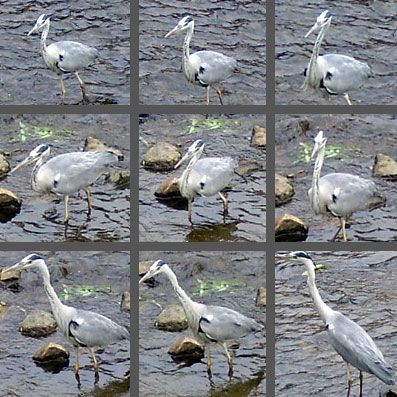
While I was sitting on the wall by the river taking pictures, a bunch of pigeons came to see what I was looking at. They wondered if it might be food.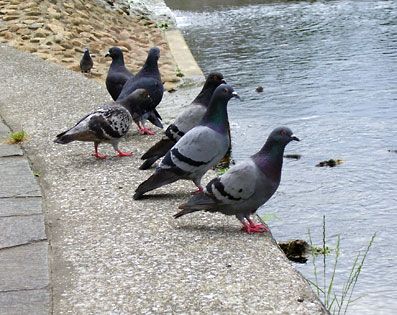
A baby sparrow also flew down rather wobblily and landed right beside me. I could tell it was a baby because of the fluff still sticking out of its feathers. Also, it had no survival skills. Birds aren't supposed to land right next to people like that. I could have reached out and touched it.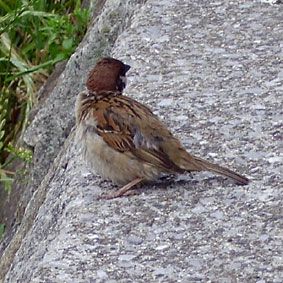
I went down closer to the water and tried to take a picture of the carp, which are too big for the egret. The egret catches smaller fish. The carp were a bit hard to see at first. Rain at the weekend made the river muddy.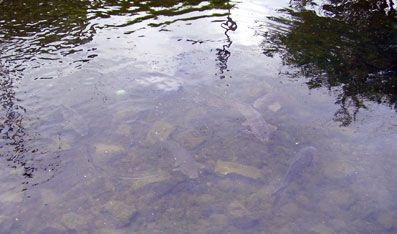
But then they spotted me, and came closer, into the shallow water near the edge. They pouted their fishy lips at me, and were disappointed that I didn't have any food. I forgot again, today.
After a while I got tired of waiting for the egret to catch another fish, and crossed the road to the little park to sit in the shade for a while and drink my bottle of vending machine Oolong. I wasn't the only person enjoying the park. There was a typical Amagasaki-type person there already.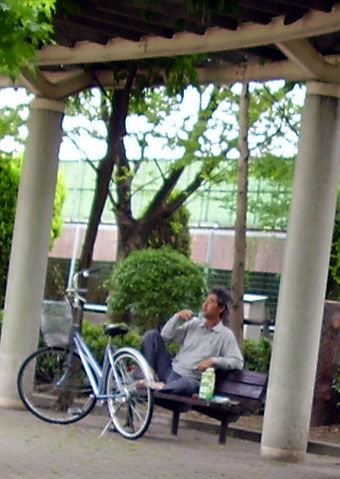
Then I cycled home, keeping an eye out for road signs. I'm collecting road signs - signs written ON roads, I mean - and will post pictures when I've amassed a few good ones. So far I've nearly been run over twice.
Technorati Tags: Japan, egret, carp, birds
A test
I taught at my very low level university today. I had only one class, and it's one I rather enjoy. It is a class of first year 'Health and Wellness' majors (i.e. Home Economics with a fancy name), and is a required class for them. Most of them hate English, and have done very badly at it in the past. I try to make it interesting for them by reading them stories and things like that.
Today I gave this class a test. I wrote on the board, "Test," and they shrieked, "NO, SENSEI! TEST??? PLEASE, NO, SENSEI! PLEASE, PLEASE!!!"
Then I wrote underneath,
"This test is not for you. It is a teacher test. If you do well, your teacher did a good job. If you do badly, your teacher has failed. She will need to try harder and teach you better."
That was different. "Ah, naruhodo," they said, ("I see") and stopped fussing.
They didn't want me to fail, so they buckled down and tried hard.
The results were breathtakingly awful. I am clearly not doing as well as I thought I was, but at least I have an idea now of what I need to do.
In the teachers' room afterwards I was chatting with one of the other teachers. She is a Japanese teacher for foreign students, and always speaks English with me. She told me she'd had very stiff shoulders, so much so that she had a dizzy spell while driving into school on Monday, and hit the gatepost. She scratched her car quite badly, but wasn't hurt herself.
I asked her if she was feeling better now.
"Oh yes," she said. "After that I got some punctuation, and now I feel much better."
She talked a little more while I puzzled over this, but it wasn't until I was cycling out the gate that I realised what she'd meant.
Technorati Tags: Japan, ESL, words
Tuesday, June 14, 2005
Telekinetic
We've been very lucky with the weather this year. We're in the middle of June, and it's still bearable. However, last week a passing typhoon pushed the rainy season rain front up from the south. This front had been hovering down there for a few weeks, as you can see in this weather chart from May 27th. 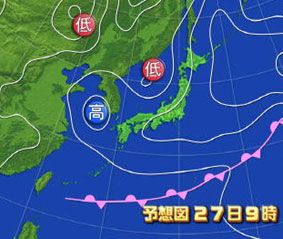
I've been holding the front down using only the power of my mind, and I hope everybody in Japan appreciates this. It's been a big strain. On Friday I was just too tired and let go for a moment, and the front instantly moved up. It rained and rained and rained, and humidity enveloped us like a mouldy old blanket.
A good sleep in on Saturday morning took care of things, though, and I was again able to apply my telekinetic powers to the rain front. By concentrating very hard I managed to push it down again, embarrassing the experts at the meteorological office who had announced the official beginning of the rainy season. I was helped along by a high pressure zone moving in from the northwest, and Sunday was a gorgeous day: sunny, clear, and dry.
But the rain front is starting to creep back again, and I don't know how long I can hold out. 
I worked too hard today, and I'm tired. On the train, on my way home I wanted to apologize to the man opposite me, who was looking perfectly calm except for his fan, which was waving frantically. "I'll get onto it just as soon as I've had a rest," I wanted to tell him. "I know I've slipped up. Sorry." 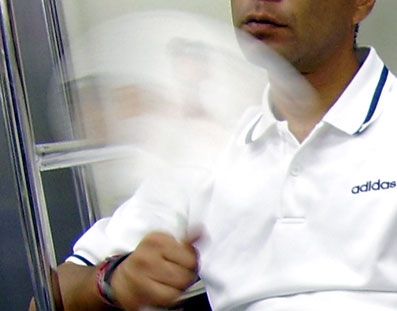
But I didn't say it. I yawned, instead. Then I yawned again, and again. That first yawn was a big mistake. I'm sure you must have noticed how yawns breed. Sometimes you can't yawn once, and this was one of those times. My face now aches from yawning. My eyes are watering and the screen keeps going blurry. Writing this is not helping, although it is a useful demonstration of my telekinetic powers. Do you believe me now? There you are on the other side of the world, yawning because I MADE IT HAPPEN.
But yawns are easy. The weather is a bigger responsibility, and I think it's time for me to pass it on to someone younger.
Technorati Tag: Japan, weather, rainy season, telekinesis
Monday, June 13, 2005
Me and Imelda Marcos
This had me picking my jaw up off the floor. It goes on and on, and on, and on, and ON. Just keep scrolling, and it goes on some MORE, until your jaw hits the floor.
I will no longer refer to myself as a packrat. I am not a packrat. THAT WOMAN is a packrat. The scale on which I measure packratism has suddenly increased its range, and I am way down the bottom, along with Imelda Marcos and her shoes. It now goes like this, in ascending order:
BadAunt and her books.
Imelda Marcos and her shoes.
(Somewhere off the top of the chart) THIS WOMAN AND ABSOLUTELY EVERYTHING.
(Via Daryl Sng, and where on earth does he find this stuff?)
Technorati Tag: packrat, Imelda, housekeeping
Sunday, June 12, 2005
Peacocks in Amagasaki
Today The Man and I cycled about fifteen or twenty minutes to a big discount store to buy some summer bedding. Our old toweling sheets are getting a bit ratty, and anyway we wanted to try something new. We'd read about some cotton gauze type sheets that are apparently very comfortable in summer.
I love cycling in Amagasaki. It's a shoddy town, and not a rich area, but there are unexpected surprises and it is always interesting. At one point we saw a dog. It was a very large dog.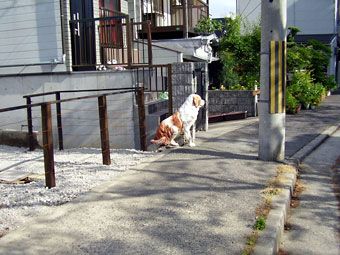
When we got a little closer, we found out why it didn't move.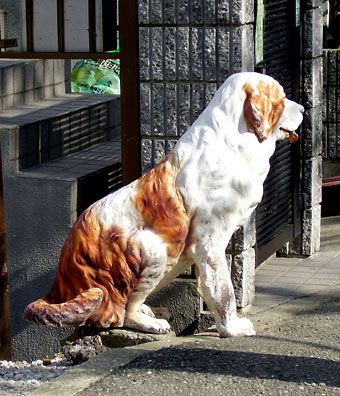
We never take the main road if we can help it, but instead get over there down little streets and along the river. I didn't take any pictures of the river, but did take some of the streets. You can see how dangerous it is to step outside your front door in some of these houses. The door fronts right onto the street. You have to peek out first to make sure a car isn't passing.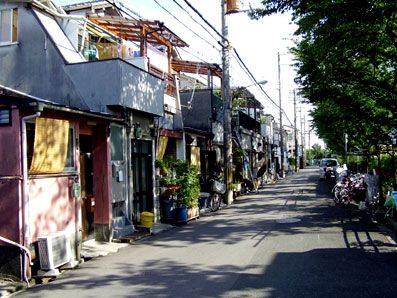
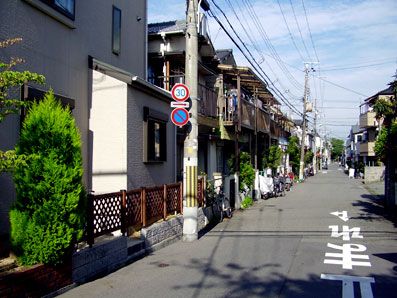
But I like taking these little streets, because you never know what might be around the corner. Of course it's usually more of the same, but still, it's fun. Now and again you come across places like this, surrounded by walls and trees, and you can't see behind the walls. What is there? A house? An old people's home? Who knows? I like the mystery of it. I don't want to know what's really there behind those walls. It couldn't possibly be as good as I imagine.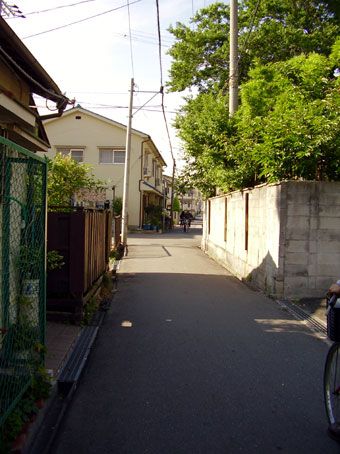
There is a place like this near our house, with walls that enclose almost an entire block. You cannot see in at all. Sometimes, in certain seasons, you can hear peacocks screaming.
Peacocks! Who has peacocks in Amagasaki, recently described in the news as a rusting industrial town just outside Osaka? The people in the coffee shop that used to be opposite the walled peacock place told us that it was mafia owned, which was a bit disappointing.
I prefer to think some eccentric rich (but not mafia) person is secretly amongst us, indulging his or her wildest landscaping fantasies behind the walls. I like to imagine a beautiful garden with exotic fruit trees and reflecting pools with fountains and peacocks and monkeys and a unicorn or two.
You never know.
Technorati Tags: Japan, Amagasaki, walled gardens
Friday, June 10, 2005
Body parts revisited, white trousers, and wrinkles
At the place I worked yesterday and today there are a large number of foreign teachers, many of whom have been here even longer than me. This makes it a good place to find out things. In the staff room yesterday at lunchtime I posed the question about body parts that came up on Tuesday evening. I asked whether anybody had ever had an operation here - or had a family member have an operation here - which involved the removal of body parts.
A few people said yes.
"So tell me," I said, "Were you shown the body part after the operation?"
"Oh, yeah!" said one guy. "You should have seen my wife's appendix!"
I didn't think I should have seen it, particularly at lunchtime, but he went on to describe it in detail anyway. He even specified what kind of sausage it looked like. I then got to hear what knee cartilage looked like, and an umbilical cord. (But apparently umbilical cords are presented to the parents, wrapped up in a little box, and not just shown.)
Perhaps living in Japan for a long time makes you insensitive, because nobody stopped eating during this rather gory discussion.
But then a few other teachers said they or family members had had operations and nothing like that happened. It seems to depend on the hospital. And perhaps on the kind of operation.
Also, The Man finally remembered that when he had his tonsils out, when he was a kid, he was shown them afterwards. Somehow that seems a bit less weird. Showing the person who was operated on seems reasonable. I'd be interested if a bit of my body had been removed. But showing the nearest and dearest? Eeeew!
Eventually someone changed the subject by reading part of a newspaper article out loud:
"Did you read this? Nearly half of Americans suffer mental disorders during their lifetime," he said, and an Australian promptly responded in a surprised tone,
"Really? Only half?"
I didn't laugh. I was still recovering from the sausage story. That was a very sick appendix.
Today I had the class that caused me such problems last week, and managed to stamp on any silliness before it could get started. I am such a spoilsport. Poor Risa looked a little hurt when I singled her out and told her to stop talking when I was talking otherwise she'd lose points, but I had to do something. She is too quick (and loud) for me, and for the other students. She understands what I'm saying, so assumes everybody else does, too. But some of them need a little time, and when she distracts them they lose track of what's going on. She's a very distracting person.
I made it up to her later, though, by teasing her about her age and her non-existent beard. We were doing descriptions of people today, and her partner described her as ninety years old (instead of nineteen) and clean-shaven He had not quite understood what clean-shaven meant, and she thought it was as funny as I did.
Koji nearly derailed things again, though, in the final activity (and thank goodness it was the final activity). After the students had written these descriptions of their partners, I collected all the bits of paper and handed them out again thoroughly muddled, and the students had to read the description, find the person described, give them the paper, and then sit down again. There was happy chaos for a while.
But then everybody returned to their seats except Koji, and I looked around to see where he was. I was beginning to think he'd sneakily left the room when a girl suddenly let out a little shriek and pointed under the empty desk next to her. Sure enough, there was Koji, peering earnestly at legs and consulting his paper.
I asked him what he was doing, and he held up his paper. "White trousers," he said, looking anxious. "WHERE?"
He was genuinely upset. He couldn't find the person on his paper, and it really upset him. The rest of the class, however, thought this was hilarious. He stood up, banging his head on the desk.
"OUCH! NO WHITE TROUSERS!" he shouted indignantly, waving his paper.
The class roared.
He was right, though. The trousers in question were light beige.
On my way home tonight, on my third train, I got on at the wrong time and couldn't get a seat. Resigned to standing for the forty-minute home stretch, I put the heavy full-of-homework bag on the floor, slung the other one more securely over my shoulder, plugged in my ear buds, cranked up the music, and gripped a strap. Almost immediately I felt a tap on my shoulder, and turned to see that an elderly gentleman was giving me his seat. I unplugged, thanked him, and told him I was all right and he should keep it. He insisted, and carried on insisting. Finally I sat down. This made him happy, but I felt a little depressed. Just how old was I looking? Also, he looked too frail to be standing. I wished someone would stand up for him - there were plenty of young people sitting and ignoring the little drama. I was pleased when several people got off at the next stop and he could sit after all.
But still, it was a special occasion. I have been in Japan for fifteen years, riding the trains most days, and that was the second time someone has stood up for me on a train. (The first time was at least ten years ago, and I definitely was not wrinkled then.) It was lovely, really, to sit when I wasn't expecting to. My legs were grateful. I'd been up since five, and on my feet most of the day.
So never mind wrinkles. If wrinkles get me a seat at the end of a long day I'm all for them.
Technorati Tags: Japan, surgery, ESL, wrinkles, trains
Thursday, June 09, 2005
TV
Current train reading: Dead Famous by Ben Elton. Having never seen a reality TV show isn't stopping me from enjoying this book enormously. It doesn't particularly make me want to watch a reality show, though. (Or want to watch TV at all, for that matter.)
Funny thing about TV and me: I keep telling myself I'll start watching it again one of these days, so I can keep up with what the people at work are talking about. We have cable. We have all the shows they talk about that sound so very interesting. The problem is that whenever I plonk myself down to watch TV I get fidgety and irritated within a couple of minutes and generally decide to read a book instead. Or surf the web. Or clean the toilet. ANYTHING. Sitting there and not doing anything gives me ants in my pants.
WHY? I used to be able to watch it. I used to WORK for a TV station, years ago. For a couple of years I was watching TV practically the whole time I was awake. I am not opposed to watching TV.
But after the head injury a few years ago I couldn't watch TV for a while. Being in the same room as a switched-on TV made me pass out - I didn't even need to be watching it. It was an extremely unpleasant sensation, as well as being aggravating. (When you can't move much for months on end you WANT to watch TV. Anything to help the time pass and distract you from pain is a blessing.)
I wonder whether that experience has anything to do with it. Maybe even though the symptoms disappeared eventually, this worked as a kind of aversion therapy. But I only tried two or three times, and surely it wouldn't work THAT effectively...?
Anyway, one of these days I'm going to watch South Park. I have it on DVD, and I keep being told it's fantastic. I believe this. I really do, and I want to have seen it.
(But I won't watch it tonight. Or next weekend. I have too much to do.)
Technorati Tags: TV, head
Wednesday, June 08, 2005
Childhood meme
I have been tagged by Wired JAFA for a meme.
Name 5 things you miss about your childhood
At first I thought it would be easier to write about five things I don't miss about my childhood, but I'm an optimist. I knew I could find five things I miss, eventually. And I did.
1. Fruit. My father had a farm, and when I was about five he planted an orchard, so I grew up with fruit. In season I ate peaches as if they cost nothing, which they did. I ate peaches galore. Peaches were my favourite, but I also ate plums and apricots and cherries and nectarines and apples apples apples. I ate and ate and ate fruit. Fruit was my candy, and there were a zillion different varieties of everything. My father planted about 10 different varieties of each fruit because he didn't want everything ripening at once and creating a fruit-picking crisis. We could never eat too much fruit. We had citrus trees at home, too, for domestic consumption. Also tree tomatoes, feijoa trees, a crab apple tree, grapes, Chinese gooseberries (later renamed Kiwi), gooseberries, strawberries, boysenberries, a few other berries, and watermelons. I've probably forgotten a few.
These days fruit costs the earth. I have never become used to paying for fruit. It was bad enough in NZ, when I left home - I had never paid for fruit in my life - but then I came here and was devastated by peaches that cost their weight in gold. AND WHY CAN'T YOU BUY FRESH APRICOTS IN JAPAN?
2. Parents. Having parents was nice. Grandparents, too.
3. Living in a HUGE HOUSE.
4. The lack of clutter. I didn't have as much clutter as I have now. I just didn't collect clutter the way I do now. I am a pack rat. The older I get the more clutter I have.
5. Swimming in the river behind the farm. Swimming in the river was one of my favourite things. Working on the orchard was one of my least favourite things (aside from eating more fruit than we picked, and driving the tractor), but lunchtime was great. We'd take the tractor and two-wheeled trailer down to the river and back the trailer up over the deep part of the river. (This was the 'swimming hole,' which changed position every year and sometimes required some tricky maneuvering.) Then we'd take running jumps off the trailer into the water. We'd stay down there for an hour or two (until Dad turned up on another tractor, to call us back, irritably) and we'd always end up with a bunch of picnicking strangers also jumping off our trailer. People - adults and children - always asked nicely, and although I sometimes got a bit annoyed at having to line up to jump off our own trailer I never mentioned this because it made me proud, too. We had the most fun set-up of anybody. Nobody else brought their own diving board to the river.
Sometimes, happily, we'd get sidetracked from fruit-picking work by somebody who'd stupidly got their car stuck in the gravel down by the river, trying to park their car too close. That was fun, too, because Dad usually sent one of the kids down to get them out. Adults get SO EMBARRASSED when they're being towed out of their foolish driving mistake by a nine-year-old on a tractor. Also, it makes them nervous. This is enormously entertaining for the nine-year-old.
The rules:
Remove the #1 item from the following list, bump everyone up one place and add your blog's name in the #5 spot. You should link to these urls - which means that this could take a while. (YOU HAVE BEEN WARNED.) You see, this is a meme with a built-in trap. You click on the links so you can get the urls, and then you start reading, and the next thing you know you've missed dinner!
Fistful of Fortnights
Feisty Repartee
Chaos Theory
Wired JAFA
Bad Aunt
Then pass the meme on...
Lippy didn't say how many people to pass it on to, but she chose four, so I will too.
I'm choosing four people from four different parts of the world: Cheryl, Wikkachicky, Berlin Bear and Lynnchan (although I'm not sure if she's old enough to have fond memories of childhood yet).
Technorati Tags: meme, childhood
Tuesday, June 07, 2005
Body parts
This evening I was talking with some friends. All of them have been here in Japan a long time. One of them is going to have surgery soon.
Now and then you hear things that make you remember that you are living in a foreign country, that this will never be anything but a foreign country, that this is just too weird to comprehend, and that you will never, ever cease being surprised by things you learn. (And maybe this is why you're here).
Tonight I had one of those moments.
What I learned tonight is that apparently, if you have surgery and some part of your body is removed (a gall bladder, a womb, an appendix, whatever), they want your next of kin (or at least close family member) to be out there in the hospital waiting, after the surgery, so that YOUR NEAREST AND DEAREST CAN BE SHOWN THE REMOVED PART OF YOUR BODY. If you are giving birth, it is the umbilical cord.
I am reluctant to believe this. It is just too outrageous. Are my friends winding me up? I will have to ask The Man when he comes home.
My friends tonight assured me that they all have heard of this, either from personal experience or from a family member or friend. But none of them knows why this is done.
The friend who is having surgery will have her husband waiting at the hospital after the surgery. She says she has instructed them NOT to take her body parts out to him to display. She has told them he is useless with things like that, and will reward them by passing out. But she is not sure whether they took any notice of her instructions. She got the feeling they were going to do it anyway, because this is Japan and this is the way things are done, here.
Thinking about it now, I have a horrible feeling it could turn out to be true and not some bizarre joke my friends are playing on me. In fact ... could this explain The Man's Mineral Collection? He has kept every kidney stone he has ever passed, washed and wrapped in tissue, in a little box. I'd always thought this was a personal idiosyncrasy, one of his strange personal habits - but could it be cultural?
Or maybe ... is the organ display thing a new custom? Maybe it is somehow connected with the various scandals there have been in recent times, when the wrong organ has been removed. Maybe the next of kin is supposed to check that the surgeon has removed the right bit.
I am trying to imagine it.
"Lemme see. Yup! That's my wife's gall bladder, definitely. Turf it! It's been nothing but trouble. Ugh."
Or, alternatively,
"Not the kidney, stupid! The spleen! Put it back and try again. Idiots."
No, it doesn't work. It can't be that. SURELY NOT. Nobody could POSSIBLY expect anybody to be able to identify a bloody body part recently removed from a family member, not even here. Would you know the difference between a spleen and a gall bladder if somebody suddenly presented you with one or the other?
I wish The Man would hurry up and come home. Thinking about this is driving me up the wall, and I want an explanation.
(But I'm not expecting him until late, so I'll inform you of his response later.)
Addendum: The Man just came home, and he looked very doubtful at this story. "I don't think so," he said. "They might show it to you, afterwards, but not to your family. I don't think. Well, I've never heard of it... Erk. Yuck."
In other words he isn't really sure, but he DOESN'T LIKE THE IDEA AT ALL.
Technorati Tags: Japan, surgery, customs
Monday, June 06, 2005
Old man
This morning I decided to leave early and spend some time at the little park near work. I haven't quite recovered from this cold, and I thought some fresh air and sunshine might be just the thing. I took some bread, to feed the pigeons, and on the way bought a bottle of Oolong tea from a vending machine, for me.
The pigeons were quickly won over, but I didn't get a chance to take any photos. While I was holding a piece of bread out in front of me and several pigeons were greedily tearing at it, a very old man, who had been sitting at the next bench, got up and moved onto the other end of my bench. He watched the birds very seriously, and after a while I gave him a piece of bread as well. He held it out, and the birds eyed him warily. After a few moments the first brave bird pecked at his bread, and before long he had his own little crowd of fans. His face wrinkled up into a smile as the birds pecked at the bread.
"It feels funny," he said, and I agreed. We grinned at each other.
He asked me where I was from. I told him I was from New Zealand, and he wanted to know where that was. He'd never heard of it.
"I've lived around here all my life," he told me. "I've never been anywhere else. Amagasaki is my home."
"It must have changed a lot over the years," I said.
"Oh yes," he replied, and went on to tell me how it was in the war years. He told me things I'd never associated with Amagasaki before, although I should have, if I'd thought about it. Amagasaki is an industrial city, so it was the target of heavy bombing. The old man told me that he used to see the American planes coming over, and sometimes the Japanese planes went up and fought them in the air, and he could see them chasing each other and turning in the air.
"I remember one time there was just one American plane," he said, "So six Japanese planes went up after it, and then suddenly lots and lots more American planes appeared. The sky was full of planes. It was terrible! And then the bombs... everything was destroyed. The shouidan!" he said, and paused. "Do you know shouidan, I wonder... people don't know this word these days..."
"No, I don't know what that means," I said.
"It's a kind of bomb," he said, "With something like oil, that burned..."
I pulled out my little electronic dictionary and looked it up.
"Incendiary bombs," I told him, "Napalm...?" I showed him the entry in the dictionary.
"That's it," he said. "When the shouidan fell on their noses the oil came out the other end and went a long way, and burned everything around. Terrible, terrible... But when they fell sideways sometimes they didn't explode, and then they were very dangerous, because they might explode later, if you touched them..."
"That must have been very dangerous for children," I said.
"Yes, it was," he said, "But the children were mostly sent away to the country. This school," he waved his hand to the elementary school behind the park, "This was my school. It closed, because there weren't enough children. But I stayed. I had to work. Oh, it was so dangerous. And we didn't know where our next meal was coming from. We were always hungry..."
He sighed.
I wished my Japanese was better. I was understanding about sixty percent of what he was saying, and I missed something around there because suddenly he was talking about the end of the war, and the time after that. He also said something about Japan's ambition to colonise Asia, and while I don't think he was saying it was a good thing, he said he couldn't understand why it made the western countries so angry.
"That's what America and England and other countries did," he said. "Of course we wanted to do it, too. We thought that's how you become rich and powerful. We wanted to be like the great western countries. They didn't stay in their own lands. They had power everywhere."
But he didn't seem bitter. He started talking about the American army bases, and the soldiers everywhere. "They came from America and Hawaii and Alaska," he told me, and I wondered if he thought these were three different countries. "They looked so smart and well-fed, and we were so poor. Even the roads were destroyed. Great big holes all over the place, and everything burned to the ground..."
Then he laughed. "But you know, after the war Japanese men were very happy, because there were fifty women for every man! It's different these days. Now there are forty-nine women for every fifty men. I read it in the newspaper. And half the women don't want to get married anyway. Fifty women for every man! Can you imagine?"
He chuckled long and loud at that one, and then became serious. "But that was because all the young men were dead," he added.
We sat in silence for a while longer. All the bread was gone, and the pigeons were now bathing in the little artificial stream. Leaves rustled in the trees overhead, the sun was shining, and we could hear children playing in the school grounds behind the park. War and bombs, fire and destruction - it all seemed far, far away, in another lifetime, another country. It couldn't happen here, I thought. But it did.
After a while I told the old man I had to go to work.
"Thank you for talking to me," I said. "I enjoyed it very much. Maybe we'll meet here again."
He waved as I cycled off.
In class I asked my students if they knew that incendiary bombs had been dropped on Amagasaki during the war. But even when I used the Japanese word, none of them knew what an incendiary bomb was. And the only hunger they know is the hunger of dieting.
Technorati Tags: Japan, war, Amagasaki, memory
Saturday, June 04, 2005
Losing the plot
Yesterday was another day of wreaking havoc in the classroom. I was not responsible. The students were responsible for their own havoc wreakage. I just sat there.
The first class went surprisingly well. This class underwent a sudden and positive change last week, and it seems to have stuck. This lulled me into a false sense of security. I thought I'd do all right, after that. I had things under control. (Ha.)
In fact the third and fourth classes went quite well, too.
The second class started off innocently enough, but in this class there are two particular students who have been 'problem students' (or perhaps I should say 'key students') from the start. This means that the behaviour of either or both of them could send the class either into spiraling heights of achievement or plummeting the dizzying depths of mayhem. Today those two students ended up sitting together.
I must have been out of my mind to let that happen. Come to think of it, I was out of my mind. I had taken cold medicine, then had three cups of coffee to counteract the sleepiness, and now and again swallowed a good wallop of codeine-based cough medicine. It was a devastating combination. I went through the day alternating between manic activity, coughing fits, and sudden, debilitating bouts of happy lethargy. I was a one woman Drug War.
Anyway, these two 'problem' students are similar in that wherever they happen to be, things happen. They are magnets for exciting moments. One of them, let's call her Risa, is a hilariously outspoken and impulsive person. Her level of English is pretty good compared to the rest of the class (which isn't saying much), and she loves to tease. She also has a very loud and joyful voice and very little self-discipline. She is funny and charming and impossible to get angry at. She just can't help herself. Something funny pops into her head and she just HAS TO ACT ON IT, RIGHT NOW, LOUDLY, and before I know it I have a happy riot on my hands.
The other problem student is a guy. Let's call him Koji. Koji's English level is very, very low, and the impression I'm getting is that he didn't ever get English, right from the start when he was in junior high school. Somehow it went straight over his head, and due to the Japanese school system, which promotes every student to the next level whether they have learned anything or not, everything just got more and more difficult until he came to the not unreasonable conclusion that he was stupid with languages. Rather than waste his energy trying something so clearly beyond him, he cultivated his talents as the class clown. He chose this role because people kept laughing at him anyway. It was a natural choice.
Koji is also an endearing sort of person. He always seems somewhat puzzled, as if he's not quite keeping up. He knows he's funny, but he isn't quite sure why. And it's true that he is at his funniest when he is not trying to be.
Koji told me, back at the beginning of semester, that he was hopeless at English. He didn't see the point of trying. He said he'd tried before and it just didn't work for him. He didn't really want to study English; it was too hard. But this is a required course, and he has to take it, and he has to acquire a certain number of language credits to graduate. He knows that. He begged me to go easy on him. He was very, very serious about this, and clearly frightened that English was going to cause him to fail in his university career.
I told him that as long as he made some effort he would pass. Nobody who makes an effort can get through any of my classes without learning something, and my standards aren't very high. I promised to help him.
At first he didn't try, but then I showed him how his grades weren't adding up and explained again that he'd get points for attempting to do the class activities (which actually means doing them, since they are not difficult). The numbers scared him, and after that he made a real effort to bend his mind to the tasks I set. I helped, as I'd said I would, and suddenly he started making some progress. This encouraged him and he became more determined. Unfortunately, it also made him funnier, because when he buckles down to his textbook and starts working on something he gets so earnest and serious he looks like a five year old trying to put Lego together. He almost grunts with the effort. Sometimes his tongue even appears in the corner of his mouth, he is concentrating so hard. And then someone laughs at him, and he looks up, surprised, and falls back into his role as class clown. People keep laughing at him because he has BEEN the class clown. Their laughter is not unkind, but they can't see him as a serious student.
Koji is persevering nonetheless, and his grades are getting better.
Today the class started off well. They did the 'free conversation' bit pretty well, considering they don't really have much language to work with. (This is a very low level class, full of the worst casualties of the 'English language education' system here.) But then, when I had them switching partners, Koji ended up with Risa as his last partner and therefore his partner for the rest of the class. Unfortunately, at that moment the codeine was winning out over the caffeine, and instead of moving them around again as I would normally do, I told myself Nah, never mind, they'll be fine, and anyway moving them is too much trouble.
I didn't know the meaning of the word trouble.
After the conversations I got them doing some activity in the textbook. They were doing all right, when suddenly - and I can't even begin to imagine what in the text inspired this - Koji and Risa were holding an arm wrestling competition. One moment they were plodding through something in the text, and the next they'd swept the desks clear and were locked in position, and the rest of the class had gathered around to watch. I sat there, bewildered and vaguely aghast, as the class started shouting and chanting and the two of them gripped hands, strained and went pink. I knew I should stop them, but the caffeine hasn't reasserted itself yet. Besides, I wanted to see how it turned out.
Koji won, but it wasn't easy. Risa is only a wisp of a girl but she held out for a lot longer than anybody expected her to. It was an exciting match. I am ashamed to admit I applauded (and laughed) just as much as anybody else.
I congratulated Koji, then told everybody to calm down and get back to their study. My laughing had brought on another coughing fit, so I ducked down under my desk and swallowed another capful of cough medicine.
"Sorry! Sorry!" cried Risa, still flushed with exertion and excitement. She knew it was all her fault, and it was. She was genuinely contrite. (She is always genuinely contrite. She doesn't know what comes over her.)
She picked up her bag, which she'd knocked over in the fight, and Koji helped her to pick up some things that had fallen out. One of these things was an eyelash curler. He held it up and gaped, mystified.
"What IS this?" he asked.
(BIG MISTAKE, KOJI.)
Risa is apparently a great believer in 'show, don't tell.' Quick as a flash she grabbed the curler, lunged across the desk, gripped Koji's head firmly, and applied the curler. It all happened too fast for Koji to react or resist. He froze as the metal contraption grabbed his stubby eyelashes and his eyelid peeled back. The one bulging eye made him look horrified.
"HAAA... HAAA... HAAA..." he gasped. "WHAT ARE YOU DOING?"
"I'm curling your eyelashes," Risa explained confidently.
The class erupted again, and again everybody gathered around to watch.
This time things went totally out of my control. I didn't have a voice yesterday. I had a croak, and it was no match for thirty-three excited students cheering on an eyelash curling demonstration. They all pressed forward to get a better view of Koji's beauty treatment. Koji sat there, frozen in position.
Risa finally released his eyelashes, and he blinked. He put one finger up to test how his eyelashes felt. He compared the curled and uncurled sides. Everybody tried to get closer to see whether it had worked.
"But they don't seem any different," he said, bewildered. "They're the same!"
Risa frowned and peered closely. "I think it's because you need mascara as well," she announced, and started rummaging through her bag.
"NOW WAIT A MINUTE!" shouted Koji, pushing back his chair. Several other students pushed it forward again and grabbed his shoulders to stop him from escaping. The rest pressed closer to get a better view of what was promising to be an interesting show. They were laughing, hooting, shouting encouragement, and making helpful suggestions about eye shadow and lipstick. Koji squirmed and looked half scared, half interested.
At this point I realised what might happen to my reputation if anybody happened to pass my classroom and glance in. I wiped the silly grin off my face, stood up, and banged on my desk with the blackboard eraser. A small eruption of chalk dust enveloped me.
There was a sudden silence, and heads swivelled. I glared as sternly as I could and tapped my textbook.
"Sorry!" cried Risa. "Very, VERY sorry!"
"Page fifteen," I reminded them.
It would have worked, too. It really would have. You could see them all remembering where they were and what they were supposed to be doing. They ducked their heads apologetically. There was an abashed silence. They were all ready to go back to their desks and get back to work. I'm sure they would have.
Except that right then, with spectacular timing, somebody farted.
The best teacher on the planet could not hope to compete with that sort of entertainment. I didn't even try. I sat down, rested my chin in my hands and let the codeine take over as the class exploded. Waves of accusations, counter-accusations, denials and laughter washed over me. Even the good students, the ones I can usually count on to behave themselves, were helpless to resist the hilarity that swept the room. Students staggered around the room banging into desks and chairs, doubled over, holding their sides and gasping. The entire class rocked with mirth.
My life had descended into uncontrollable farce, and there was nothing I could do about it.
* * *
Some days you lose the plot, and it's better to just let it go. In fact I recommend it. Letting it go felt good.
(I just don't recommend doing it too often, that's all. And make sure you have a good supply of drugs handy.)
Technorati Tags: ESL, Japan, Education
Friday, June 03, 2005
Zombie teacher
Teaching on cold medicine is interesting. Yesterday I learned which of my classes have learned how to self-propel, and which haven't. It came down to fifty-fifty.
The doctor had given me stronger medicine to dry up the noisal discharge, and all day a tiny little man with a tiny little vacuum cleaner was hard at work inside my sinuses, sucking them dry. This new medicine is so effective I kept expecting my face to collapse. I was also very, very thirsty all day, and since the medicine made me sleepy I drank a lot of coffee.
The physical sensations were accompanied by a happy, spaced-out feeling, and I didn't really care much about anything. This is not a very good condition to teach in, and at around 6.30, when the last class had finished and I was eating dinner, and the second dose of the day had well and truly worn off, I started to worry about how far I'd set myself back. How long is it going to take me to get those two bad classes back on track? The others went fine - the students just carried on, following instructions and teaching themselves and each other and using me as a resource - but in those two bad classes many of the students didn't DO anything, because I wasn't being 'mother' and urging them back on task every five minutes as I usually have to do. I just sat there, happily spaced out and marking them down in my gradebook. Quite a large number of the students did nothing I could grade them on, so I didn't. I took notes instead. It was easy to take notes, because I wasn't wandering around the class urging them to do the work. I took really detailed notes.
Hiroshi: Reprogrammed phone (15 minutes), gossiped with partner (J) (10 minutes), read magazine (J) while still gossiping (multi-tasking!) (20 minutes), slept (25 minutes). Textbook unopened, no English spoken, written, read, or listened to. Percentage of task achieved: 0%. Points for today's classwork: 0. Shot self in foot.
I wrote notes like this for about 18 students, out of 28. Now and again I looked over what I'd written and thought, I should be appalled, but I wasn't appalled. Appalled seemed to have temporarily departed my emotional lexicon. Instead I was irrationally delighted. Amazing! I thought. Absurd! And Ha ha!
A few students did work hard, and asked questions, and learned something. I gave them full points for making such efforts despite the distractions around them. They'll get full points in the review test next week, too. The good classes were far more tiring, because they were so much more demanding.
But after work I got worried. Will the bad students think I've gone soft and expect to get away with it again next week? Have I made my job harder for myself? I was awful. I let down the good students by not stopping that nonsense. They trusted me, and I failed them.
Feeling discouraged and tired I took my last dose of medicine for the day. Before long I couldn't see what the problem was. Who cares? I pretend to teach and they pretend to learn. Isn't that what Japanese universities are all about?
When I got home I went to bed quickly before the medicine wore off. Now it's 5 o'clock and I'm up again, ready to wreak havoc and destruction on another day of classes.
Technorati Tags: ESL, Japan, Education
Wednesday, June 01, 2005
Funny
Student evaluations. You've got to laugh. A few weeks ago I was given the results from the evaluations that were done at the end of last semester at one university, and I just got around to opening the envelope.
This is the course evaluation form designed by the school, not my own evaluation form. I think I've mentioned before that I always get my students to fill in a survey at the end of semester. My one is a form I design myself and which the students have to answer in English. The purpose of this is to find out what parts of the course they thought were the most and least useful, to get them to think about what they learned, to ask them if they thought anything important was missing from the course, and so on. All the questions are open-ended.
I give students this form after I have told them their final grades, on the last day, and ask them to reply honestly. I ask them to include their negative comments as well as positive, because negative answers especially help me to improve the classes next semester. I am the only person who will read their answers, I explain. Their grades are already fixed, and they've already had a chance to dispute them if they wish to, in class. (I do this to avoid the tortuous process of having them do this through official channels, later.)
My evaluation forms are not anonymous, because I want to be able to check the answers against the student's record if they have anything especially bad or good to say about the course. For example, if a student tells me he or she couldn't understand what was going on in the class most of the time, I want to know if this was a student who paid attention and was usually on time. If the student was consistently late, or spent class time sending text messages, or sleeping, I give the comment far less weight than I would in the former case.
The students take this survey very seriously, and take a lot of time answering the questions. I get some interesting and helpful answers. (I also get several declarations of love every semester, which is nice.)
But the answers I get on the official student evaluation forms are often quite different, and the students rarely take more than five minutes to fill them out, although there are more questions. Students do not seem to take these as seriously (because they are anonymous?) even though they are more important as far as the school is concerned. I don't think many students know what these evaluations are really for. To them it is just another meaningless form the university requires them to fill out. I can't tell them that their answers will help me, because they won't. If one student writes that my class is too hard, how can I judge that comment? What if that was the student who came to class only twice? I have no way of knowing. In any case I don't get to see the results until they've all been collated, and that is usually after the next semester has already started. Also, students only have to choose a number on a scale to answer each question, not write out answers, which means that quite frequently they will choose the path of least resistance and not bother reading the questions. I notice this when we get the forms back.
What is likely to happen, if the student likes you, is that they read the first question to find out which end of the scale is 'good,' and write the top number. If they want to look more serious they'll write the second-to-top number. (The bottom and second-to-bottom numbers if they don't like you.) Then they go through the entire form without reading the rest of the questions, writing the same number for all of them. This can wreak havoc with your results when suddenly the 'good' answer switches ends, as happened one year with a poorly designed questionnaire. It can also give you an overly good evaluation when most of the questions are on a one to five scale but one or two of the questions only go up to three, as happened another year with yet another poorly designed form. The universities collate all the answers using computer, and the computer does the GIGO thing and spits out an impossible percentage result. (105%! I was a better than fabulous teacher that year, with a very small class of students who liked me.)
I don't know what I scored on this latest evaluation, though - the one I just opened - because the university has suddenly gone all high tech this year and given us the collated results on a (gasp) floppy disk. Finally, we have moved into the twentieth century! I have an old floppy disk reader I hadn't used for a couple of years, and miraculously was able to open the file, but there the miracle ended because I was presented with a page of gibberish, in Word. I don't expect the results to be particularly good, though, because the one really important question at the end of last semester's questionnaire: What is your overall rating for this teacher and class? was suddenly on a 1 - 10 scale, whereas all the other questions were on a 1 - 5 scale. Several students who had written 5 for everything also wrote 5 for the all-important last question. The fact that this simply does not make sense (This teacher is perfect in every way but overall I'll give her 50%???) will not make a jot of difference to anything. The school will have it on my permanent record that I scored low on the overall rating. Idiots.
At another school they must be using the same questionnaire form mentioned in this article, because the same two questions always turn up at the beginning. Every semester I hear my students asking each other, "Syllabus? What syllabus? What does it mean?"
After they sort that out, they generally answer 'yes' to both questions. I think the students like me, there, because the writer of the article speaks of very different results:
What kinds of questions are being asked in the Japanese version of lecture evaluations? As far as I know, most of the questionnaires begin with these questions:This is, of course, absurd, but I am lucky in that my students are kinder liars. They say yes they read the syllabus, which they didn't, and they say yes I followed it, which is also not true. I never do, at that school. That is because I write the syllabus myself, and at the time that I write it I have almost no information about the class beyond the title. I am asked to teach, for example, "Oral Communication 2B," "English Expression 1a" and "English Communication IIB." (Yes, there really is this odd combination of upper and lower case, and Roman and Arabic numerals.) I ask about the students who will be taking these classes, and find out that, say, one of the classes is for English majors and the others are open to all majors. I ask what the course titles mean, and what the difference is between them, and get dusty answers. Nobody is quite sure. The class titles just sounded good, I suppose. What level will the students be? Not sure. Will the class include foreign students? Maybe. How many students can I expect? We'll get back to you, they say, and never do.
Question 1. Did you read the lecture syllabus before first attending class?
Question 2. Did the lecture proceed according to the syllabus?
The problem is that far too many students answer ``no'' to both questions.
So I write a fuzzy syllabus for each class, and ignore it thereafter.
It's worse when the school gives me straight answers, though, because these are usually wrong. I wrote a syllabus for a class I'm teaching this year which I was told would be taken by low-level students, second year, non English majors, around 30 students. What I got was five students. Four are very high level and one is intermediate. I chose a completely unsuitable textbook, based on the information I was given, and my syllabus would bore the students to tears if I took any notice of it. I don't, of course.
I can't remember what I started out intending to say, but I'll end with this.
I was just flipping through the evaluation forms they sent back with the floppy disk, and came across one where a student had apparently decided that the comments section had to written in English (it didn't). She (or he) has written:
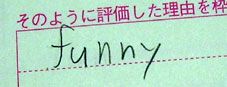
And that pretty well sums up the whole student evaluation system, if you ask me.
Technorati Tags: Japan, ESL, StudentEvaluations


